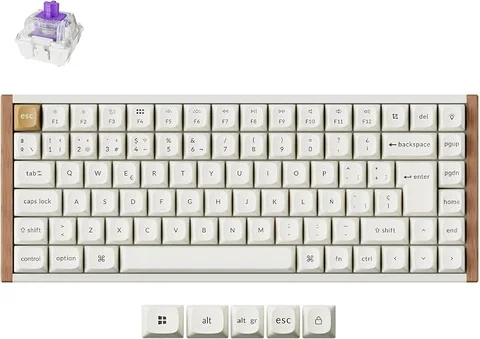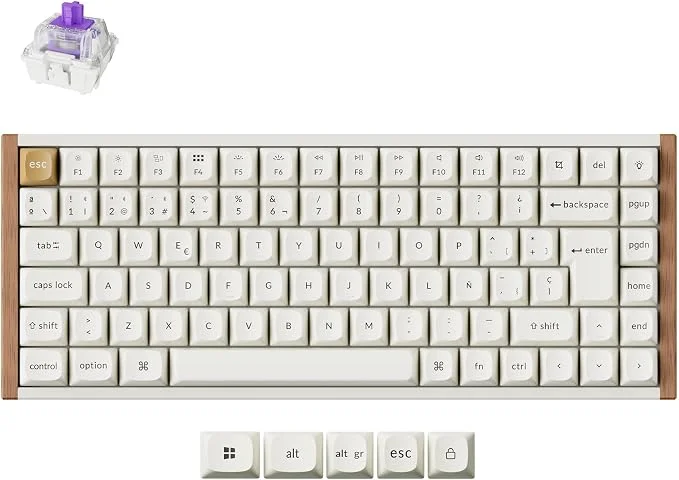
Choose a low-profile mechanical keyboard if a thinner board and shallower typing action fit your routine. Choose a normal-profile mechanical keyboard if you prefer a fuller travel feel and the customization options of your selected switch system. Both are mechanical; low-profile is not a synonym for laptop-style membrane construction.
The Keychron K2 HE in our collection is a standard-height Hall effect example. Its magnetic switches differ from ordinary mechanical switches and accept compatible Gateron double-rail replacements only. Keychron’s K3 family provides a useful low-profile reference, but compare exact versions rather than treating all keyboards with the same first letter as equivalent.
Height is only part of the difference
| Decision | Low-profile mechanical | Normal-profile mechanical |
|---|---|---|
| Physical goal | Thinner assembly | Standard-height switch and keycap system |
| Typing feel | Often shallower travel; check the switch | Often fuller travel; check the switch |
| Carrying | Thinness can help a travel setup | Size depends on layout and case |
| Customization | Compatibility can be more model-specific | Many options within compatible systems |
| Noise | Depends on switch, case, keycaps, and use | Depends on switch, case, keycaps, and use |
Gateron’s profile explanation describes the mechanical differences. Keychron’s low-profile comparison shows that even one manufacturer’s low-profile products use several configurations.
Compare keyboard height with your desk setup
A thinner front edge may suit a setup where your hands already sit close to the desk surface. A taller board may suit someone who prefers its key travel and has arranged their chair, desk, and support accordingly. Profile alone cannot establish which is comfortable for a particular person.
Try ordinary work rather than typing a few impressive sentences. Use your normal shortcuts, number keys, and navigation commands. Notice whether you repeatedly bottom out, miss keys, or need to reach awkwardly. Those observations are more useful than assuming thinner is automatically easier to type on.
Keep layout separate from profile. A 75% normal-profile board can take up less desk width than a larger low-profile board. If the problem is reaching for the mouse, width and layout may matter more than switch height.
Keycaps and switches are a compatibility decision
If customization is part of the appeal, make a list of the parts you intend to change. Check switch socket type, keycap mount, stabilizers, and clearance for the exact keyboard. A stem that looks familiar does not guarantee every keycap will fit without interference.
Low-profile systems can differ between generations and manufacturers. Normal-profile boards also have limits: not all are hot-swappable, and not every socket accepts every switch. Buy the demonstrated combination rather than a general promise of unlimited customization.
For an upgrade from a classic K2, read K2 vs K2 Pro. That guide compares the original mechanical models; the K2 HE in our catalog is a separate magnetic-switch family.
Thin does not automatically mean quiet
Noise depends on the mechanism, switch type, case, caps, and how the board is used. A low-profile clicky switch can still be an unsuitable choice in a shared room. A normal-profile board can be quiet or loud depending on its configuration.
When quiet typing is the requirement, look for recordings or measurements of the exact configuration and conditions. A product video with music underneath is not useful evidence. The same caution applies to gaming: profile is not a measured latency ranking.
Frequently asked questions
Are low-profile keyboards mechanical?
They can be. This guide specifically compares mechanical products; thin membrane and scissor-switch keyboards form a different comparison.
Can I put low-profile switches into a K2?
Do not assume compatibility. Check the keyboard’s sockets, switch system, and manufacturer instructions for the exact version.
Which profile should a laptop user choose?
A low-profile board may feel like a smaller transition, but that is a preference to try, not a universal rule. Layout, switch force, and travel all affect the result.
Explore the Workspace collection for the catalog’s keyboards and accessories.