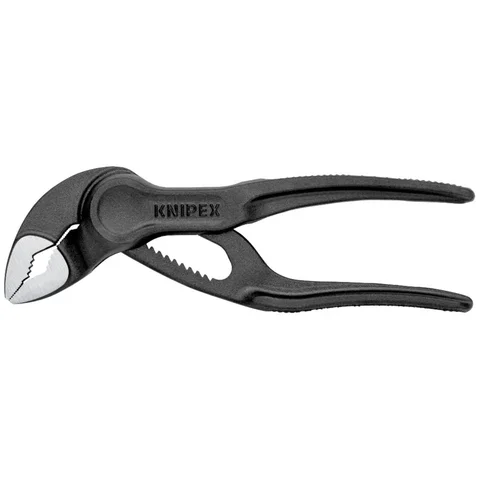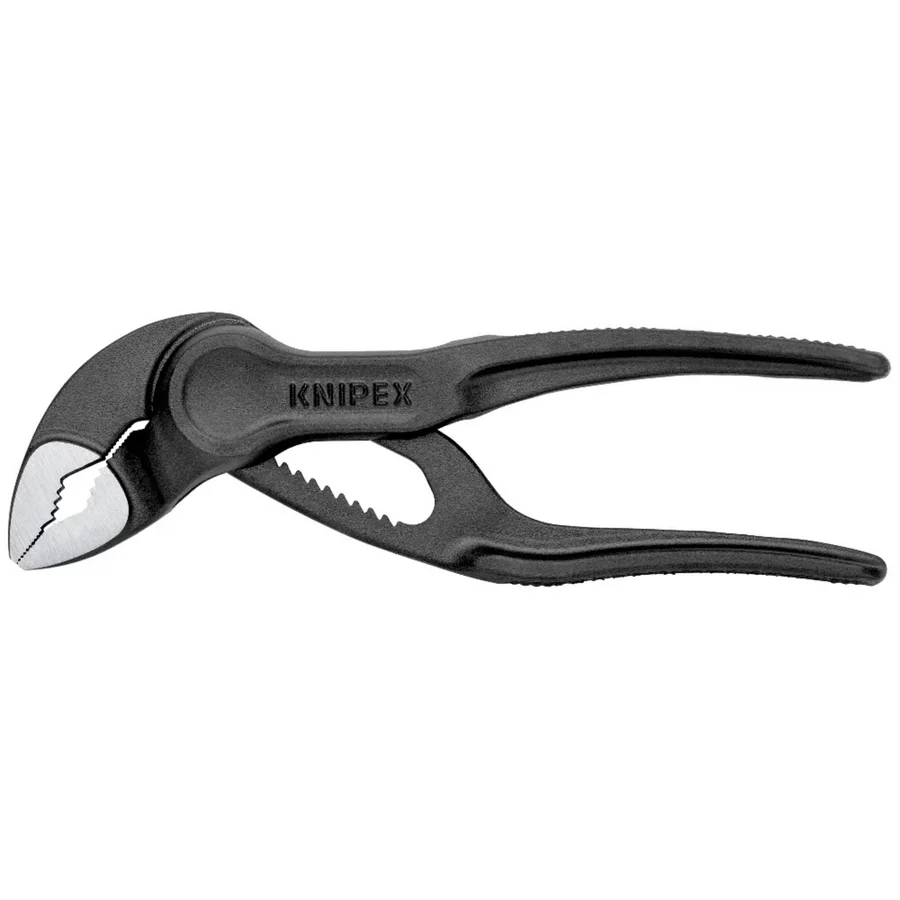
Choose Knipex Cobra XS when gripping round or irregular parts is the main job. Choose Pliers Wrench XS when you mainly need parallel jaws on flat-sided fasteners. Both are compact, but their jaw designs make them different tools rather than competing versions of the same miniature wrench.
The Cobra XS in our collection is the 100 mm model. This guide compares it with the 100 mm Pliers Wrench XS, not larger versions with different capacities and leverage.
Jaw shape explains the choice
| Decision | Cobra XS | Pliers Wrench XS |
|---|---|---|
| Jaw approach | Toothed gripping jaws | Smooth parallel jaws |
| Natural starting task | Grip round or irregular workpieces | Work on suitable flat-sided parts |
| Manufacturer length | 100 mm | 100 mm |
| Stated capacity example | Round workpieces up to 28 mm | Up to 21 mm across flats |
| Important distinction | Grip can mark a surface | Correct engagement still matters |
Knipex’s XS set documentation lists both tools and their capacities. Its Cobra XS explanation describes the gripping role. Round diameter and width across flats are different measurements; do not rank the tools simply by comparing 28 with 21.
Think about the last job you actually needed a tool for
Was it a round fitting, an awkward part to hold, or a small hex fastener? That history is more useful than imagining every possible emergency. Pick the jaw design that matches the work you repeatedly encounter.
Cobra’s toothed jaws are a reason to consider it for grip. They are also a reason to think carefully about a finished surface. Pliers Wrench’s parallel-jaw arrangement is a reason to consider it for flat-sided work, but a small adjustable tool is not automatically the best choice for every nut or bolt.
If a correctly sized spanner or socket is available for a particular fastener, compare that option too. Carrying one flexible pocket tool and equipping a workshop are different decisions.
Capacity is not leverage
A part fitting between the jaws does not establish that the small tool is appropriate for the force required. A 100 mm handle is deliberately compact. Its main advantage is having a small tool available, not replacing every larger tool in a kit.
Before treating either as your only maintenance tool, consider what happens when a fastener is tight, access is limited, or the workpiece needs firm support. Follow Knipex’s intended-use guidance and select an appropriate tool for the actual job rather than applying extra force to compensate for size.
For everyday carrying, the useful question is how often this compact form gets used. A larger tool left at home can be less convenient for small tasks; a tiny tool pushed beyond its role can be the wrong purchase.
One tool or both?
Start with the one that matches your common task. The manufacturer sells a set because the roles can complement each other, not because every owner needs two nearly pocket-sized tools.
If you often need to hold one part while turning another, two tools may be useful. If your occasional task is always a small flat-sided fitting, a single Pliers Wrench may cover it. If you frequently need a general gripping tool, Cobra XS may earn its place first.
Include the carrying pouch or protection you want when comparing current prices. Check whether the retailer’s price covers a single tool or a two-tool set, and which accessories are included.
Frequently asked questions
Is Cobra XS a substitute for Pliers Wrench XS?
Not for every task. Their jaw designs and capacity measurements differ; choose according to the part you need to grip or turn.
Which is better for finished fasteners?
The smooth parallel-jaw tool is the one to investigate first for appropriate flat-sided work. Correct fit and technique still matter, and this guide does not establish a universal no-marking guarantee.
Should I buy a larger version instead?
Yes if the actual work needs its reach, capacity, or leverage. Pocket size is useful only when it fits the job. Browse the Carry collection for other project tools.