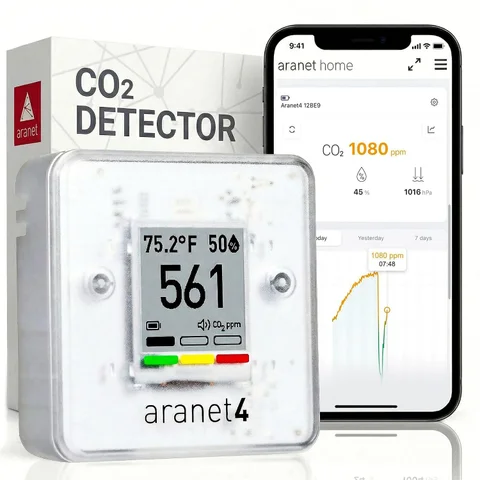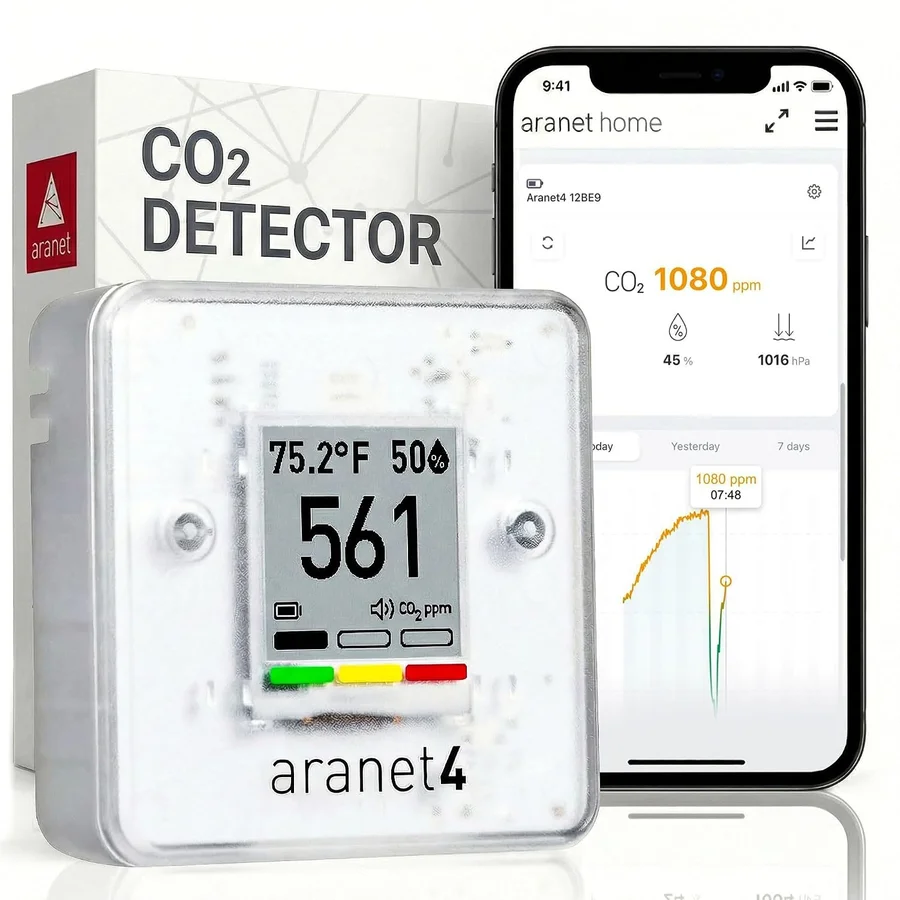
Choose Aranet4 Home if you mainly want a portable CO₂ reading and local history for the places you spend time. Choose Airthings View Plus if you want several indoor-air measurements and a connected view of one location. First decide what you need to measure; a longer sensor list is useful only when you will act on it.
The Aranet4 Home in our collection is the home model. Do not confuse its capabilities with an Aranet professional sensor and base-station system.
Focused measurement versus a broader picture
| Decision | Aranet4 Home | Airthings View Plus |
|---|---|---|
| Measured factors | CO₂, temperature, humidity, pressure | Adds radon, PM2.5, and VOC measurements to those factors |
| Main use in this comparison | Portable room checks | Broader monitoring of a chosen room |
| Connectivity | Bluetooth app connection | Wi-Fi connectivity and online data access |
| CO₂ method | NDIR sensor | Check the documented sensor specifications |
| First buying question | Is CO₂ the reading I need? | Will I use the additional measurements and connected history? |
Aranet’s Home documentation and Airthings’ View Plus page describe the measured factors. CO₂, particulate matter, VOCs, and radon are different measurements; one cannot substitute for another.
Start with a question about the room
For a portable CO₂ device, the question might be whether readings change during a meeting or after ventilation. For a fixed monitor, it might be how several readings change across days in the same room. Those questions produce different placement and data requirements.
Decide whether the device will move between rooms or stay in one place. Moving it can help you inspect different environments, but it also changes the context of the history. A connected monitor left in one location can be more useful for comparing that location over time.
Neither choice should be made solely from the number of graphs in an app. Identify the information you will look at and what decision it will support.
Calibration and placement matter
Read the manufacturer’s setup instructions before interpreting a new reading. Allow the required stabilization and calibration time, and place the device as instructed. A reading beside a person breathing directly onto the sensor is not necessarily representative of the whole room.
Aranet’s FAQ explains calibration requirements. Follow the current instructions for your environment rather than assuming that an automatic-calibration setting can operate correctly under every room-use pattern.
Additional sensors may also have different settling or averaging requirements. Avoid comparing two units immediately after unpacking and presenting the difference as proof that one is inaccurate. A useful accuracy assessment requires an appropriate reference and controlled conditions, which this guide does not provide.
Connectivity changes ownership
If you want to take a monitor between rooms and inspect readings nearby, Bluetooth may cover the intended routine. If you want remote access to readings from a fixed location, inspect the Wi-Fi, account, and data-access requirements of View Plus.
Also consider where the device can be placed, how it will be powered, and whether you want the display visible. Check available export and history features if you intend to keep your own records. These are practical ownership questions, separate from the accuracy of the sensors.
A monitor reports measurements; it does not itself ventilate or purify a room. Do not interpret a single CO₂ number as a complete assessment of every indoor pollutant or a guarantee of safety.
Frequently asked questions
Does Aranet4 Home measure particulate matter or radon?
No. Its documented measurements are CO₂, temperature, relative humidity, and atmospheric pressure.
Is View Plus better because it measures more?
It covers more factors, but that does not establish a comparative accuracy winner. Choose it when those additional readings are relevant to your monitoring plan.
Can I compare readings from two different rooms?
You can observe them, but interpret each with its location and conditions. Different placement, occupancy, and timing can explain differences without either device being faulty.
Explore the Home collection.